
German word frequency: the words worth learning first
You must have come across words that you never seem to be able to remember. Why is it that you remember some words better than others when learning German? The answer is word frequency.
Where frequency lists come from
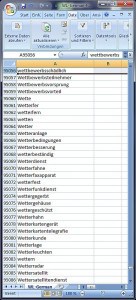
Word frequency analysis is not new. It dates back to 1898, when Friedrich Wilhelm Kaeding published a frequency dictionary, not because of an interest in teaching German but because he wanted to develop a new shorthand system for German. Despite his intentions, his frequency list has enjoyed regular application in teaching German as a foreign language. The basis for a frequency list is a corpus, a structured collection of texts intended to be a representative sample of the German language: newspaper texts, literature, radio and TV broadcasts.
Vocabulary can be learned randomly, as it occurs in a natural, authentic setting, or systematically, as is usually the case in a structured learning environment. Each approach has its advantages and disadvantages, but lexical frequency information is helpful for learner and tutor alike.
What the numbers tell you
The most frequent words in German are the definite articles der, die and das and their various forms. You may already know that German has three definite articles depending on the gender of nouns. Your German teacher has undoubtedly stressed the importance of learning the gender of nouns. The definite articles occur about 155,000 times in every 1 million words. In other words, not knowing the correct articles has the potential of making 1.5 mistakes with every ten words, thus stopping you from speaking German fluently.
The second most frequent German word is und, a straightforward coordinating conjunction that joins two main clauses. The word sein occurs 24,500 times per 1 million words, but only if we talk about the verb. The word sein as a possessive pronoun only has 3,650 occurrences per 1 million words. This shows that besides the meaning of a word, it is vital to know its function and how to use it in the German language, i.e. how to conjugate a verb or decline an article.
Do you need a frequency dictionary?
A frequency dictionary can be of great help when learning German. It does not, however, replace a conventional bilingual or monolingual dictionary. Unless you already speak German at an intermediate or advanced level, there is no need to buy a frequency dictionary. But that does not prevent you from learning frequent words or making your own German vocabulary lists according to word frequency.
Learn the vocabulary by knowing the meaning of the German word in your language and then recall the word in German. Recalling a German word will be much more challenging than learning the meaning, but it is vital when speaking accurate German with a degree of fluency.
A tutor builds your vocabulary around the words you need, in private German lessons in London or online German lessons.