
Can AI teach you German? Where a tutor still matters
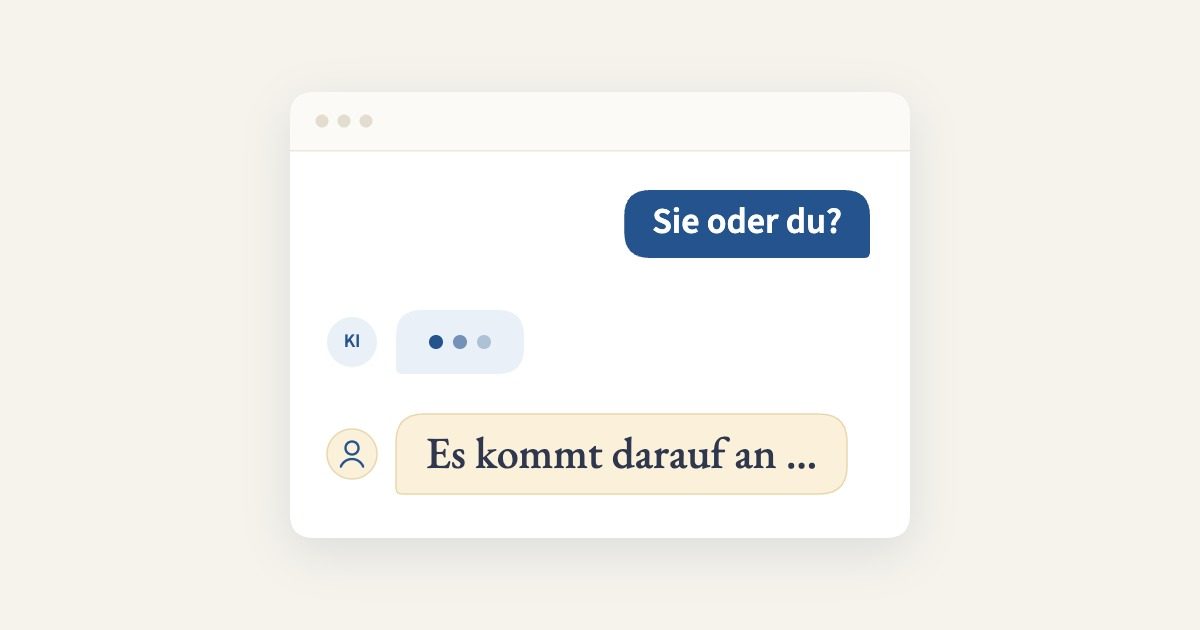
Can AI teach you German? I have started using it myself to create exercises, so this is not an article warning you off. After more than two decades of teaching adults, I find a different question more useful: what is AI good for, and where does a person still make the difference?
What AI does well for German learners
It is always available. Ten minutes on the train, late in the evening, the day before a meeting: AI is there whenever you have time, and short, regular practice is what makes a language stick.
It explains without judging. Many students hesitate to ask a question they feel they should already know the answer to. With AI, you can ask about the dative case umpteen times, unembarrassed and without worrying that your tutor might lose patience.
It creates practice material on demand. Example sentences, gap-fill exercises, short texts at your level, all on topics that matter to you, whether that is your industry, your new home town or your partner’s family.
It builds vocabulary for your field. Whatever your work or interests, it will produce a tailored word list in seconds.
It corrects written German. Paste in a draft email and it will tidy up the grammar and suggest more natural phrasing.
It lets you rehearse conversations. You can practise small talk before visiting your in-laws or run through a presentation before you give it, as often as you like.
Where a native German tutor still matters
It doesn’t know what you most need. AI works on what you bring to it, and learners tend to bring what they are unsure about. The mistakes that hold you back are usually the ones you don’t know you are making. A tutor hears them when you speak freely, decides which one matters most and keeps coming back to it until it is fixed. Just as important, a tutor lets the smaller slips go while you are speaking, so you keep your fluency and your confidence.
It can be confidently wrong. Its errors tend to sit where learners are least able to spot them: regional usage, idiom and questions of register such as whether to say Sie or du. If you cannot yet judge the answer, you cannot tell when it is wrong.
It has read German, not lived it. AI has seen more German text than any person ever will, but it has never sat in a German meeting, joined a family celebration or grown up in Germany. A native German knows first-hand how the language is spoken today and the culture behind it: what sounds natural and what sounds stiff, when humour works and when it falls flat, and the unwritten rules behind both. There is no substitute for hearing it from the horse’s mouth.
A patient machine is not a real conversation partner. AI generally waits for you to finish. A German colleague or neighbour interrupts, speaks quickly, changes the subject and has an accent of their own. Confidence comes from handling that, which is why it pays to practise German outside the classroom as well as in lessons.
A reminder is not a commitment. Language apps can send reminders and count streaks, but a notification is easy to swipe away. A lesson with a person who is expecting you is much harder to skip, and that regularity is what moves learners forward: how long it takes to learn German depends more on time and commitment than on aptitude.
How to combine AI and German lessons
The simplest way to think about it: use AI for volume, and a tutor for direction and real conversation with another person. AI gives you more practice than any weekly lesson can. The lesson decides what that practice should focus on: the mistakes you keep making without noticing, and the situations you need German for.
Three prompts that work well between lessons:
- “I am learning German at B1 level. Write a text of about 150 words on [topic] using everyday vocabulary. Then ask me five questions about it, one at a time, and correct my answers.” If you are unsure of your level, this guide to A1 to C2 will help.
- “Here is an email I have written in German. Correct only the mistakes that would confuse a German reader or sound impolite, and explain each one in a sentence.”
- “Play the role of my German mother-in-law. Speak at a natural pace and ask follow-up questions. After ten exchanges, tell me the three mistakes I made most often.”
Then bring what AI produced to your next lesson: the text you couldn’t quite follow, the correction you didn’t understand, the phrase you weren’t sure you could use. It makes lesson time far more productive.
If you are learning for a move, a partner or family, AI is ideal for everyday vocabulary and daily practice. Lessons give you conversations that feel real and the confidence to hold your own.
If you are learning for work, AI helps you prepare emails and the vocabulary for a meeting, including polite requests in business emails. The small talk before the meeting, the negotiation itself and the judgement of when to switch from Sie to du come from practice with a person.
What about German exams?
If you are preparing for a B1 or B2 exam, AI is useful for writing practice and for model answers to compare with your own. The speaking test is different: you speak with an examiner, often together with another candidate, and under time pressure. Rehearsing that with a person remains the most reliable preparation. The B1 German course and exam article covers what the test involves.
The bottom line
AI has already started to change how people learn German, and it will keep doing so. The goal is the same as ever: to speak with confidence to real people in real situations. That’s where a tutor fits in.
Last reviewed: September 2026