


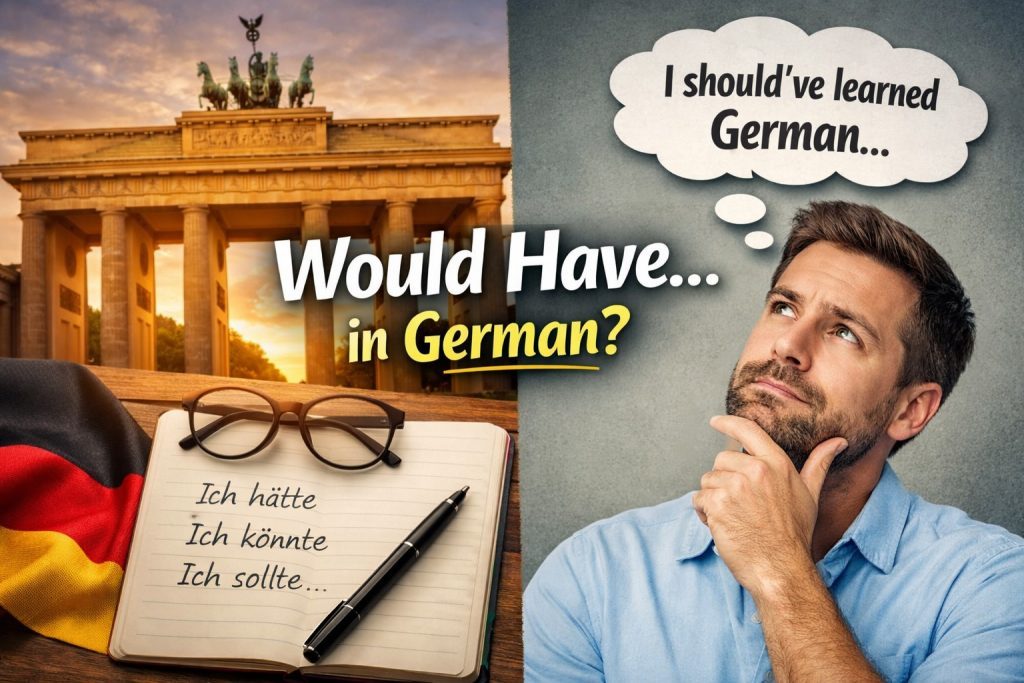
Should’ve learned German. It’s a thought many learners have at some point — often when looking back at a missed opportunity, an awkward situation, or a conversation that didn’t quite go as planned. In German, expressing these kinds of reflections relies on Konjunktiv II in the past. This form allows you to talk about what could have, should have, or would have happened, while keeping the tone natural and nuanced.
Expressing “would have” in German
In English, phrases like “I should have replied earlier” or “We could have handled that differently” are common. German uses a comparable idea, but the grammar works differently. Instead of relying on word order or auxiliary verbs alone, German combines hätte or wäre with the past participle to create this sense of hindsight or unrealised possibility.
What Konjunktiv II in the past is used for
At its core, Konjunktiv II in the past is used to describe situations that did not happen. You are not talking about facts, but about alternatives, regrets, or imagined outcomes. This makes it useful when reflecting on past decisions, explaining missed chances, or softening criticism.
The structure: hätte/wäre + past participle
The basic structure is straightforward once you see the pattern. For most verbs, you use hätte plus the past participle. For verbs of movement or change of state, you use wäre instead. This mirrors the way the perfect tense works in German, but with Konjunktiv II forms of haben or sein.
“Should have” in German
For example, instead of saying “Ich habe es gelernt” (I learned it), you would say “Ich hätte es lernen sollen” to mean “I should have learned it.” The action did not take place, and the sentence clearly signals that you are looking back with hindsight.
Modal verbs and hindsight in German
Modal verbs play a central role here, just as they do in English. Ideas like should have, could have, and would have are expressed in German by combining modal verbs with Konjunktiv II in the past. The key is understanding how these modals work with the structure — so you can communicate naturally rather than building sentences word for word.
Expressing Regret with “should have”
“Should have” in German often expresses regret or mild self-criticism. A sentence like “Ich hätte früher anfangen sollen” communicates that you recognise, after the fact, that an earlier start would have been better. It’s reflective, which makes it suitable for professional or polite contexts.
Talking about missed possibilities with “could have”
“Could have” tends to focus on missed possibilities. Saying “Wir hätten das Problem vermeiden können” highlights an option that existed in the past but wasn’t taken. This phrasing is especially useful when analysing situations, without assigning blame.
Describing hypothetical outcomes with “would have”
“Would have” is commonly used when describing hypothetical outcomes. For instance, “Das hätte besser funktioniert” suggests that under different circumstances, the result would have been better. This form allows you to comment on past situations without stating things too directly.
A key difference between English and German
One important difference between English and German is that German often prefers these Konjunktiv II past forms even where English might simply use the past tense. Using the correct structure signals a strong command of nuance and helps avoid sounding overly direct or simplistic.
This takes a little practice
Learners sometimes hesitate because these sentences can feel long or complex at first. However, they follow consistent patterns. Once you’re comfortable forming past participles and choosing between the Konjunktiv II form of haben and sein, the rest becomes much easier.
Syntax in Konjunktiv II (past)
Word order: In German, the past participle appears at the end of the clause. This is especially noticeable in longer sentences, but it’s an essential feature of clear, idiomatic German. With practice, this placement starts to feel natural.
Beyond regret: tone and diplomacy
Konjunktiv II in the past is not limited to expressing regret. It’s also used to be diplomatic, to reflect thoughtfully, and to discuss alternatives without sounding harsh. That makes it highly relevant not only in everyday conversation but also in professional communication.
A turning point for adult learners of German
For many adult learners, mastering this structure marks a turning point. It allows you to move beyond describing what did happen and start expressing what might have happened instead. This adds depth and flexibility to your German and makes your speech and writing sound more confident and considered.
“Should’ve learned German” — and what comes next
So yes — you might say Ich hätte früher Deutsch lernen sollen. But once you understand how this form works, you’ll also be able to explain decisions, reflect on experiences, and communicate hindsight with clarity and subtlety. That’s a powerful step forward in mastering German for work.
Frequently asked questions
When do you use hätte and when do you use wäre in the Konjunktiv II past?
Use hätte with most verbs. Use wäre with verbs that describe movement or a change of state — the same verbs that take sein in the perfect tense. If a verb forms its past tense with sein, it will also use wäre in the Konjunktiv II past.
Can you use Konjunktiv II past without modal verbs?
Yes. Konjunktiv II in the past can be used on its own, without modal verbs, to describe hypothetical outcomes or alternative past situations. Sentences like Das hätte besser funktioniert focus on the imagined result rather than on obligation or possibility. This usage is very common in reflective or evaluative contexts.
What’s the difference between Konjunktiv II in the past and the simple past or perfect tense in German?
The simple past or perfect tense describes what actually happened. It states facts about the past in the indicative. Konjunktiv II in the past, by contrast, is used to describe unreal, imagined, or hypothetical past situations — things that did not happen.
For example, Ich habe das gelernt states a fact: you learned it.
Ich hätte das lernen sollen makes it clear that the action did not happen and is being considered in hindsight.
Using Konjunktiv II in the past allows speakers to reflect, evaluate, or soften statements about the past, rather than simply reporting events. This distinction is essential for sounding precise and natural in German.
Is Konjunktiv II in the past used in both written and spoken German?
Yes. Konjunktiv II in the past is used naturally in both spoken and written German whenever speakers want to reflect on the past, express regret, or describe hypothetical outcomes. In conversation, it often appears in short, common phrases, while in writing, it can sound slightly more structured and deliberate, similar to the German passive voice . Either way, it’s a normal, widely used part of everyday German — not something limited to formal situations. For example, a very natural way to express “should’ve learned German earlier” is: Ich hätte früher Deutsch lernen sollen.
If you’d like to work on structures like this in a practical way, private German lessons can help you apply them confidently in real situations.