


German passive voice is a structure many learners encounter early on, yet rarely feel fully confident using. The formation is straightforward, but its purpose and tone can feel unfamiliar to English speakers. In professional contexts, particularly in written communication, the passive voice appears frequently. Understanding how it works — and when it is appropriate — helps you read and write German with greater accuracy and control.
What is the German passive voice?
At its core, the German passive voice shifts the focus of a sentence from the person performing the action to the action itself. Instead of naming the actor, the sentence highlights what is being done. This shift is common in formal writing, reports, and situations where the actor is unknown, unimportant, or deliberately left unspecified.
How the German passive is formed
In English, the passive is formed with “to be” and a past participle: “The report was written.” German forms the passive differently. The standard structure uses the verb “werden” together with the past participle. In a passive sentence, the object of the active sentence becomes the grammatical subject. For example, in the active sentence “Jemand schreibt den Bericht” (Someone writes the report), “den Bericht” is the object. In the passive version, “Der Bericht wird geschrieben”, the report becomes the subject, and the person performing the action is either omitted or introduced separately.
The basic formula for the German passive voice is straightforward:
Subject + form of werden + past participle
For example:
Der Bericht wird geschrieben.
The report is being written.
Here, “wird” is the present tense of “werden”, and “geschrieben” is the past participle of “schreiben”. The emphasis is not on who is writing the report, but on the action of writing itself.
In the past tense, the passive is formed using the simple past of “werden” together with the past participle. The pattern remains consistent.
Der Vertrag wurde unterschrieben.
The contract was signed.
Here, “wurde” is the simple past form of “werden”. In written German, particularly in reports and formal communication, this form is used regularly to describe completed actions without emphasising who carried them out.
It is also possible to form the passive with the perfect tense, although in practice the simple past is more common in written German.
Der Vertrag ist unterschrieben worden.
The contract has been signed.
While grammatically correct, this structure can feel heavier. In formal written contexts, the simple past passive is often preferred for clarity and conciseness.
Passive voice with modal verbs
Modal verbs can also be used in the passive voice. In this case, the structure becomes:
Subject + modal verb + past participle + werden
For example:
Der Bericht muss überarbeitet werden.
The report must be revised.
Here, “muss” expresses necessity, while “werden” remains in the infinitive at the end of the clause. This construction is very common in professional settings, particularly when expressing obligation, possibility, or recommendation.
Das Problem kann gelöst werden.
The problem can be solved.
As in active sentences, the modal verb shapes the meaning, but the passive structure itself remains consistent.
When the German passive voice is used
One important question is when the passive voice is actually used. German, like English, does not rely on the passive for every formal sentence. However, it is frequently employed when the actor is obvious, unknown, or irrelevant. In reports, instructions, and official communication, the focus often lies on procedures and outcomes rather than on individuals.
For example, in a business context, a sentence such as:
Die Unterlagen werden geprüft.
places emphasis on the process of reviewing the documents, not on who is reviewing them. This creates a neutral and objective tone, which is often desirable in professional writing.
That said, overusing the passive can make a text feel heavy or impersonal. German writing generally values clarity and precision. In many situations, an active sentence is clearer and more direct, particularly when responsibility or agency needs to be stated explicitly.
Compare:
Wir prüfen die Unterlagen.
We are reviewing the documents.
Both versions are correct, but they place emphasis differently. The passive highlights the process, while the active highlights the people involved. Choosing between them depends on what matters more in the context: the action itself, or the person carrying it out.
The state passive in German (Zustandspassiv)
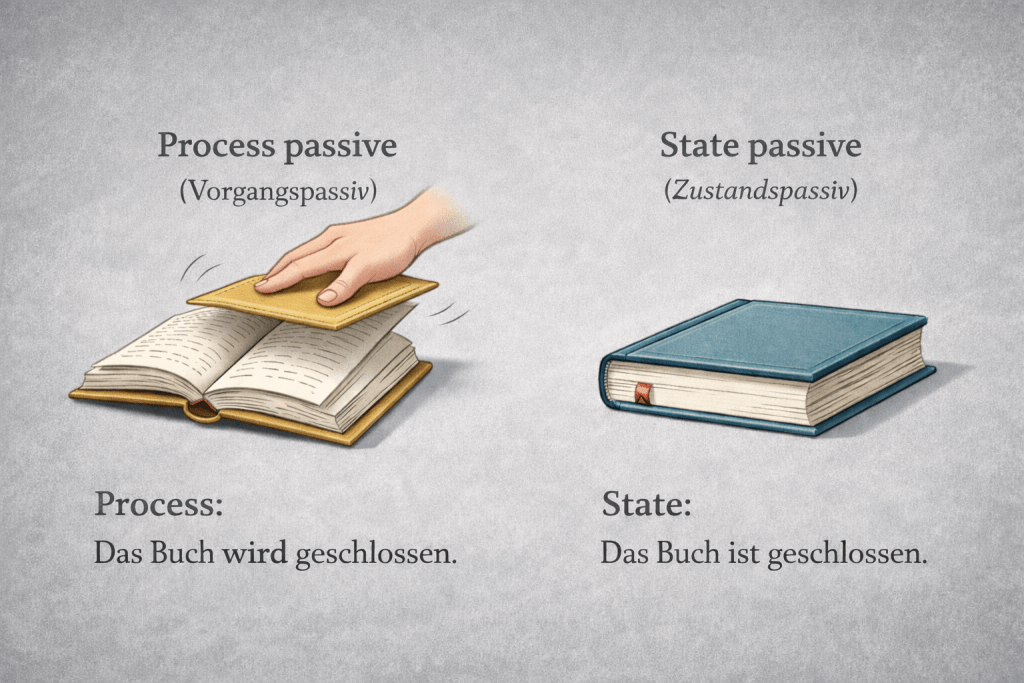
German also distinguishes between what is often called the process passive and the state passive. The process passive describes an action taking place, using “werden” and a past participle. The state passive, by contrast, describes the result of an action and is formed with “sein” and a past participle.
Understanding the difference between process and state is important, particularly in written German. Compare the following:
Die Tür wird geschlossen.
The door is being closed.
Die Tür ist geschlossen.
The door is closed.
In the first sentence, the action is taking place. In the second, the action has already happened and the focus is on the resulting condition. Confusing these two forms can change the meaning of a sentence significantly.
Using the German passive effectively
The German passive voice is formed with “werden” and a past participle when describing a process, and with “sein” and a past participle when describing a resulting state. Its purpose is to shift attention away from the person performing an action and towards the action itself. This shift is particularly common in formal, factual and process-oriented contexts.
In professional writing, the passive can create a neutral tone and place emphasis on procedures and outcomes rather than individuals. Used carefully, it contributes to clarity and objectivity. Used excessively, it can make a text feel impersonal or unnecessarily heavy. The key is not simply knowing how to form the passive, but understanding when it improves precision and when a direct active sentence would communicate more clearly.
In short, the German passive voice shifts attention from the actor to the action and is most common in formal, factual and process-oriented contexts.
For professionals in London who need to use structures such as the German passive voice confidently in reports, emails and formal communication, focused one-to-one tuition can make a significant difference. If you would like structured support tailored to your professional context, you can find more information about our private German lessons here.